CI
The name, the symbol and the colour. Together they say what kind of company this is.
Symbol
Material · Formation ·
Precision · Beauty
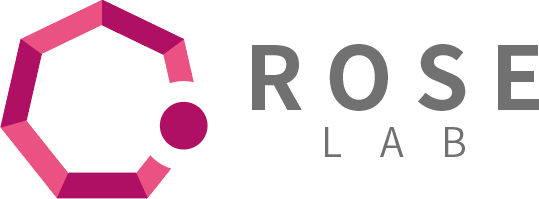
The ROSE LAB symbol is not decoration. It is a structural formula — a drawing of the material the company works with.
A ring of seven sides, and a single circle detached from it. This renders the ring structure of ε-caprolactone, the unit molecule from which polycaprolactone (PCL) is built.
ε-caprolactone is a compound whose seven atoms form a single ring. When that ring opens and the units join, they become a polymer. The symbol's ring is open at one point, one atom set apart — the instant before a material turns into something else, held still.
So this is not a closed figure. The unclosed ring stands for research that is not finished; the single detached circle for precision that allows no drift. All of it drawn in the colour of a rose.

The seven-sided ring
The material itself — the ring structure of ε-caprolactone.
The open point
Where material becomes polymer. Research that has not stopped.
The detached circle
A single atom. Precision that allows no drift.
The colour of a rose
Where we are headed. Beauty and health.
Name
One name,
two meanings
ROSE carries a double meaning. It points to beauty, and at the same time to research. Both axes of the company are folded into the one word.
The rose — a symbol of beauty
The rose has stood for beauty for as long as the word has existed. What ROSE LAB works towards is, in the end, human beauty and health. The first meaning names that destination.
R.O.S.E. — Research On Special Elements
At the same time ROSE is the initials of four words: research into the special element. This is how the company reaches that destination — a sentence unchanged since its founding in 2016.
R · O · S · E
Research On the Special Element
Join the four words and they spell ROSE. The flower and the sentence share the same letters.
A company that researches special elements. That sentence became the name. So what makes an element special? ROSE LAB holds to three answers.
It did not exist
Existing materials yield existing answers. What we look for is a material not yet put to use.
It is safe
For anything used on the body, safety comes before efficacy. A material whose safety cannot be shown is taken off the list.
It becomes a product
A material that stops at the laboratory remains a paper. Only once it clears approval, is manufactured and reaches a hand does it do any work.
Origin
Founding purpose
To become a medical technology company that leads the development of innovative materials — through the convergence of new technologies and for safe clinical application — for human health and a beautiful life.
ROSE LAB Inc. opened on 13 May 2016 under this founding purpose. The name, the symbol and the colours all come from that single sentence.
Since then the company has concentrated on the development of biocompatible tissue-restoration materials, centred on polymer chemistry, tissue restoration and aesthetic medical device manufacturing, and life science.
Logotype
Signature
The symbol and wordmark are used as a horizontal lockup. Full colour on light backgrounds, white reversed on dark.
Primary — light background

Reversed — dark background
Color
Corporate colours
ROSE LAB has three colours. Two of them are not different colours at all, but two states of the same one.
The colour of ROSE LAB is magenta — taken from the point where a rose is at its deepest, so that name, symbol and colour carry one story.
The symbol is not flat but folded. Some faces catch the light and some fall into shadow, and so a single magenta appears as two. They are two states of one colour, not two colours.
One reticent grey completes the set at three. The fewer the colours, the clearer each one becomes.
The colour at the point where a rose is deepest. The one colour ROSE LAB shows outward, used only where emphasis is needed. Spread wide, it loses its force.
- HEX
- #AF1064
- RGB
- 175 · 16 · 100
- CMYK
- 35 · 100 · 35 · 0
- PANTONE
- ≈ 675 C
The same magenta with light on it. It supports the primary and never stands in front alone. Suited to small accents on dark grounds.
- HEX
- #E95283
- RGB
- 233 · 82 · 131
- CMYK
- 0 · 80 · 20 · 0
- PANTONE
- ≈ 205 C
A colour that keeps quiet. Softer than black, firmer than grey — legible on any ground without drawing attention. This is why the name is set in it.
- HEX
- #717171
- RGB
- 113 · 113 · 113
- CMYK
- 0 · 0 · 0 · 70
- PANTONE
- ≈ Cool Gray 10 C
HEX and RGB are the on-screen reference values; CMYK is the print original as specified in the master Illustrator file. CMYK and RGB diverge depending on the conversion profile, so each medium uses its own value. PANTONE values are approximate — the master file carries no spot colour, so the definitive match must be confirmed against physical chips.

We are looking for partners
We welcome distribution, partnership and product enquiries.